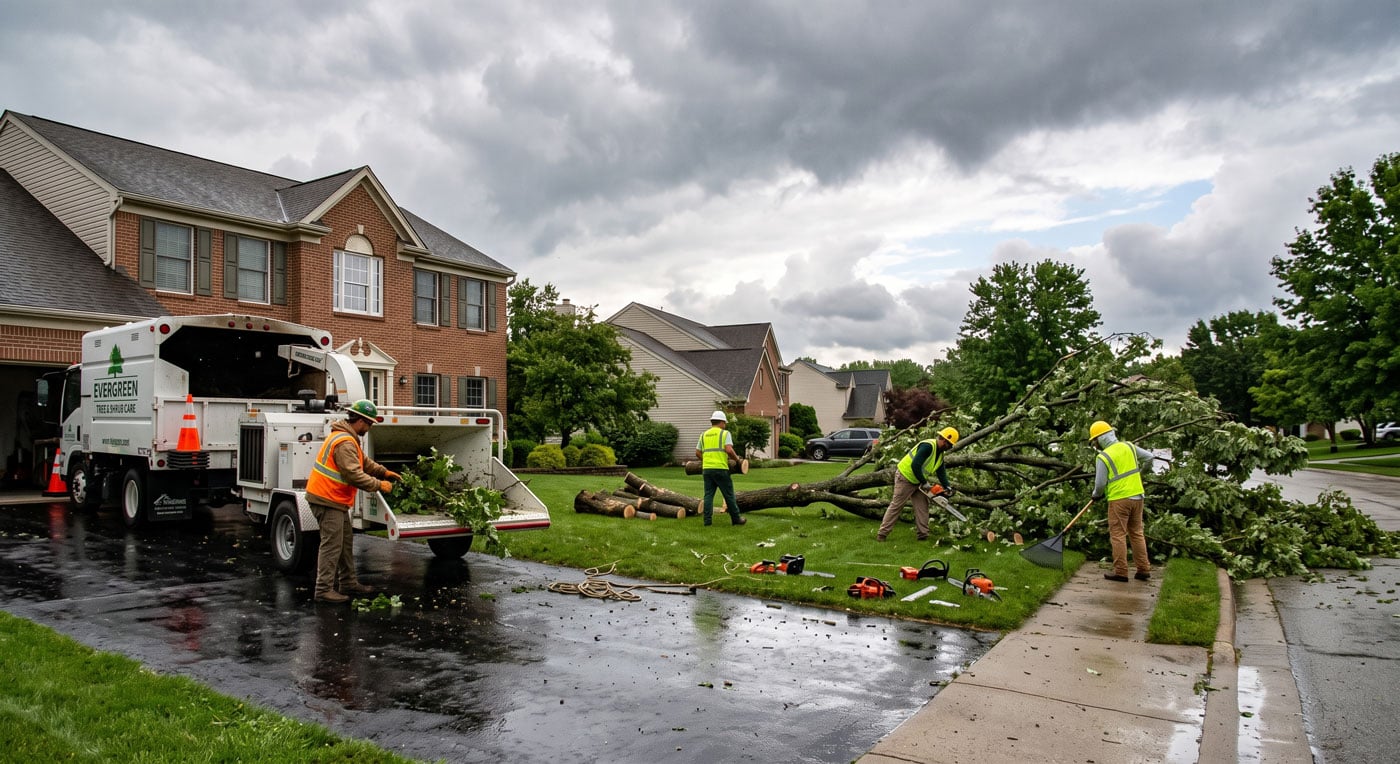
The schedule fills after every storm. Phones ring, crews stay busy, estimates stack up. Then the weather holds for three weeks and the calendar empties just as fast. For most tree service companies, that cycle is not a bad luck problem. It is a tree service marketing problem - and the fix is not more ads. It is a system that generates demand before the storm hits rather than one that only captures it after.
Capturing that surge before it fades starts with a plan for turning storm damage calls into tree service leads the moment the storm passes.
The tree service companies that break the feast-or-famine cycle have one thing in common: their marketing is working while their crews are working. Local search visibility, Google Local Services Ads, a review generation process, and a website built to convert - each piece running consistently, not only when the weather turns bad. That system is what turns a storm-dependent business into one with a predictable pipeline.
This post covers what a complete tree service marketing system looks like, which channels move the needle for this ICP, and what the difference looks like in real numbers from a real tree service company.
Why Most Tree Service Marketing Fails
The most common mistake tree service companies make with marketing is treating it as a storm-response tool rather than a demand-generation system. Ads go up after a big weather event. Leads spike, crews book out, and the budget gets paused when things slow down. Then the next dry spell hits and the cycle starts over.
The second most common mistake is hiring agencies that do not understand how homeowners actually find and choose a tree service company. A homeowner with a hazard tree or a yard full of debris is not doing a considered research process - they are searching, scanning reviews, and calling whoever looks credible and available. An agency that optimizes for clicks rather than map pack rankings and verified lead volume is solving the wrong problem.
The contractors who build consistent schedules are the ones whose tree service marketing system is running whether or not there has been a storm. They show up in the map pack for "tree removal near me" in January. They have enough reviews to win the comparison before a homeowner calls anyone. Their website converts traffic into estimate requests at every hour of the day. That foundation does not get built overnight - but once it is in place, it compounds.
For the paid complement to organic rankings, see our guide to Google Ads campaign structure for tree service companies.
The Foundation: Local Search Visibility
The majority of tree service leads start with a local search. "Tree removal [city]." "Emergency tree service near me." "Stump grinding [county]." These are high-intent searches from homeowners who have a problem right now and are ready to call. The tree service company that dominates those searches does not need to wait for referrals or storm chasers to fill the schedule.
Google Business Profile
The Google Business Profile is the single highest-leverage asset in tree service marketing, and most companies treat it like a static directory listing. The ones that win the map pack treat it as an active marketing channel. That means uploading job photos weekly - before and after shots from completed removals, stump grinding jobs, and large-scale clearance work. It means responding to every review, publishing posts about seasonal services, and keeping service areas and categories current. BrightLocal research shows that the vast majority of homeowners read reviews before contacting a local service business - your profile is often the decision point before they ever visit your website.
Service and Location Pages
A single "services" page will not rank for the specific searches your best customers use. Homeowners search for specific services in specific places: "tree removal Raleigh NC," "emergency tree service Wake County," "stump grinding near me." Each of those searches deserves a dedicated page that matches the query, describes the service, shows real project photos, and makes it frictionless to request an estimate. This is the SEO foundation that generates organic leads at no cost per click once established. For a full breakdown of how service pages, local SEO, and reviews work together into a single system, see our home service lead generation guide.
Reviews
Reviews do two jobs simultaneously for a tree service company: they influence rankings in the map pack and they influence the homeowner's decision before they call. A consistent review generation process - a text with a direct review link sent within 24 hours of every completed job - keeps both working in your favor. The companies that fall behind on reviews do not just lose the trust comparison. They lose map pack position to competitors who are generating review velocity consistently. For a full breakdown of how to build a review system that compounds over time, see our guide to Google reviews for tree service companies.
Working with a specialist
The foundation takes time to build. The results compound once it is in place.
If you would rather have a team that already knows how tree service companies get found, chosen, and booked build this for you, see how The Diamond Group works with tree service companies.
How The Diamond Group works with tree service companies →Paid Channels: Capturing Demand When It Spikes
Organic local search builds the baseline. Paid channels capture the demand spikes - storm season, high-wind events, the first hard freeze of the year. The two paid channels that consistently produce the highest ROI for tree service companies are Google Local Services Ads and Google Search Ads, and they work best when they are running together as part of the broader home services marketing stack.
Google Local Services Ads
LSAs sit above every other result at the top of the search page and operate on a pay-per-verified-lead model. You only pay when a homeowner actually contacts you - not for clicks that do not convert. For residential tree work, LSAs are the highest-ROI paid channel available. The barrier to entry - Google Guaranteed verification, insurance documentation, and background checks - filters out operators who cannot or will not clear it, which means your listing carries implicit trust that a standard Google Ad does not. For a step-by-step breakdown of how to set up and optimize LSAs specifically for a tree service company, see our guide to Google Local Services Ads for tree service companies.
Google Search Ads
Search Ads fill the gaps where LSAs have coverage limits - specific services like crane work, commercial removals, or lot clearing that LSAs do not always capture well. They also work for targeted seasonal campaigns: running aggressive bids on "storm damage tree removal" and "emergency tree service" in the 48 hours after a significant weather event. The key is tight geographic targeting, high-intent keyword selection, and landing pages that match the specific service being searched. Sending paid traffic to a homepage is one of the most common and expensive mistakes in tree service advertising.
The Website: Where All the Channels Converge
Every channel eventually sends traffic to the website. If the site does not convert that traffic into estimate requests, the rest of the system underperforms. A tree service website that generates consistent leads needs four things: dedicated service pages for every major service and location, visible trust signals - insurance, certifications, years in business, reviews - above the fold, a clear phone number and estimate request button on every page, and fast load times on mobile where most homeowners are searching. Most tree service websites were built to look professional. The ones that fill schedules were built to convert a homeowner who found them at 9pm after a branch came down. For a detailed breakdown of what a converting tree service website requires, see our guide on building a tree service website that turns visitors into booked jobs.
What This Looks Like in Practice: A+ Tree and Crane
A+ Tree and Crane spent ten years cycling through agencies and trying to build their own marketing, watching the same budget produce little to nothing. Their Google Ads account had fragmented campaigns competing against each other internally, driving the cost per lead to $292. The website generated traffic but did not convert it. There was no cohesive strategy connecting paid ads, organic search, and social.
The Diamond Group audited every channel before spending a single additional dollar - paid ads, website, SEO, and social - and rebuilt the foundation under the same $5,000 monthly budget. Google Ads were restructured to eliminate internal competition. LSAs were optimized for residential leads. The website and landing pages were rebuilt to convert paid traffic. A full local SEO and content strategy was built for the Raleigh and Triangle market.
The result on the same budget: 1,811% more conversions at a cost per lead of $15.83 - down from $292. The phones have not stopped ringing since. That result did not come from spending more. It came from building the right system - and that is what tree service marketing is actually supposed to do. The broader framework that produced those results is the same home services marketing system The Diamond Group builds for contractors across trades.
What to Track So You Know What Is Working
Tree service marketing that runs without tracking is just spending. The numbers that matter are not impressions or clicks - they are booked estimates, cost per booked job, and average job value by channel. When you know which channel produced your last ten booked jobs, you can stop funding the ones that fill your calendar with the wrong work and put that budget into the ones that produce profitable removals and high-margin maintenance contracts.
Call tracking tied to your CRM is the most practical way to get there. Every inbound call should be tagged to its source - Google Ads, organic search, LSAs, or direct - so the connection between marketing spend and booked revenue becomes visible rather than assumed. Most tree service companies have no visibility into this. Building it early means every budget decision from that point forward is based on data rather than instinct.
Building a tree service marketing system that works year-round - not just after a storm - requires the right foundation, the right channels in the right order, and tracking that connects spend to booked jobs. Getting all of that running correctly from the start is exactly where a specialist makes the difference.
Built for tree service companies
Stop living storm to storm. Build a schedule that holds.
The Diamond Group builds marketing systems for tree service companies that fill the calendar with high-margin jobs year-round - not just when the weather turns. Local SEO, LSAs, Google Ads, and a website built to convert, all connected to booked jobs and real revenue.
See how we work with tree service companiesAbout The Diamond Group
The Diamond Group is a Wilmington, NC based digital marketing and web design agency committed to helping today's small businesses grow and prosper. With a 30-year track record of success, their proprietary in-house system and concierge-level multi-disciplinary team approach to marketing guarantees double-digital growth and optimizes marketing ROI.
Related Posts
Tree Service Marketing Case Study: 1,811% More Leads