Before a homeowner visits your website, reads your reviews in full, or calls your number, they see your Google Business Profile. The map pack - the three local business listings that appear at the top of search results for queries like "tree removal near me" or "emergency tree service" - is built almost entirely from GBP data. Your category, your photos, your review count, your response time, your service area: these determine whether you appear, where you appear, and whether a homeowner who sees your listing decides to call. For a tree service company, getting the Google Business Profile right is not a marketing add-on. It is the foundation that every other channel builds on.
The gap between tree service companies that dominate local search and those that wonder why the phone is quiet is almost never about the quality of the work. It is about whether the GBP is being treated as an active marketing asset or a form that got filled out once and forgotten. A profile that is complete, current, and consistently maintained will outrank a better-equipped competitor whose profile has been dormant since setup.
This post covers how to build and maintain a Google Business Profile specifically for a tree service company - the category decisions, photo strategy, review connection, and ongoing signals that move rankings and win homeowners before they ever click through to your website.
Why GBP Matters More for Tree Service Than Most Trades
Tree service searches are among the most locally concentrated and urgency-driven in the home services category. A homeowner whose oak came down in a storm is not going to page two of search results. They are calling whoever appears first in the map pack that has enough reviews to look credible. That means the window between "homeowner searches" and "homeowner calls" is measured in seconds, not minutes - and your GBP is the only thing visible in that window.
The trust dynamic also makes GBP more consequential for tree service than for lower-stakes trades. Inviting a crew with chainsaws, bucket trucks, and cranes onto a property near the house, power lines, and the fence is a decision that requires a baseline of trust before the homeowner will pick up the phone. Your profile's review count, rating, photo quality, and Google Guaranteed badge from LSA verification are the signals that establish that trust at a glance. According to Google's guidance on how the local pack works, businesses with complete, accurate, and actively maintained profiles are significantly more likely to be surfaced for relevant local searches. In a high-trust, high-urgency category like tree service, that visibility difference translates directly to calls.
Category Setup: The Strongest Relevance Signal You Control
Your primary category is the single most influential signal Google uses to determine which searches trigger your listing. For a tree service company, the primary category should be "Tree Service" - not "Landscaper," not "Arborist," not "Contractor." The primary category tells Google what your business fundamentally does, and Google uses it to match your profile to the queries homeowners are typing.
Secondary categories expand the range of searches your profile can appear for without diluting the primary signal. The right secondary categories for a tree service company depend on what work the company actually does. "Tree trimming service," "stump removal service," and "arborist" are the most commonly applicable. If the company also does land clearing, "land clearing service" can be added. If emergency work is a significant part of the business, "emergency tree service" is worth including where available as a category option.
The mistake to avoid is listing categories for services the company does not actually offer in an attempt to expand search coverage. Google's local ranking algorithm is sophisticated enough to detect mismatches between categories and actual business activity - review content, website content, and user behavior all feed into how Google evaluates relevance. A tree company with "landscaping" as a secondary category that does no landscaping work will not rank for landscaping searches and may dilute the primary relevance signal it is trying to build for tree removal.
Service Area: Define Where You Work, Not Where You Wish You Worked
Tree service companies are service-area businesses - they travel to the customer rather than having customers come to them. This means the service area settings in GBP carry more weight than the physical address for determining where the profile appears in local search results. Setting the service area accurately is both a ranking input and a conversion input: a homeowner in a city you have listed as a service area who sees your profile has reason to believe you will come to them, while a homeowner outside your area who calls and gets turned away is a wasted interaction for both parties.
The right approach is to list every city, county, or ZIP code where the company regularly takes jobs - not every geography within a two-hour drive. Overextending the service area in an attempt to capture more searches tends to reduce ranking performance in the core markets that actually drive revenue. Google weighs proximity as a local ranking factor, and a profile claiming to serve a 150-mile radius looks less credible to the algorithm - and to homeowners - than one with a focused, realistic service territory.
Photos: The Ranking Signal Most Tree Companies Ignore
Profile photos are a direct ranking input, not just a cosmetic feature. Google's local ranking algorithm uses photo activity - upload frequency, photo count, and user engagement with photos - as a signal that a business is active and operating. A profile that has not had a new photo uploaded in six months is a profile that is signaling dormancy. A profile with new job site photos added two or three times per week is signaling an active, working business, which is exactly what Google is trying to surface for homeowners with urgent needs.
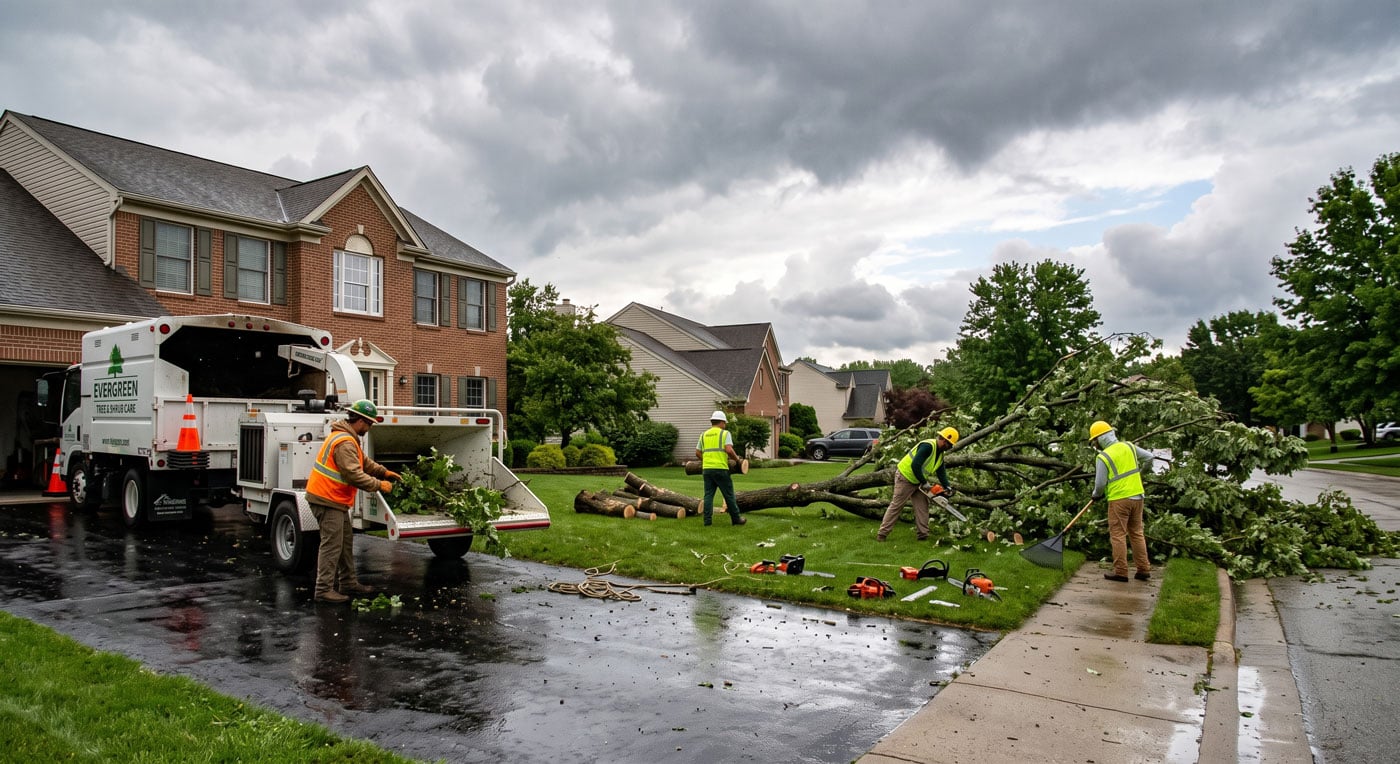
For tree service specifically, before-and-after photos are the highest-converting content type on the profile. A homeowner evaluating whether to call is trying to answer one question: can this company handle my job? A photo of a massive oak being removed cleanly from a suburban backyard, crane visible, debris cleared, answers that question without a word of copy. Real job photos from real projects - tagged with the service type and general area where possible - build both ranking signals and conversion simultaneously.
The photo upload schedule should be consistent rather than sporadic. Two to three photos after each significant completed job, uploaded within 24 hours, produces the kind of steady activity signal that compounds over time. A burst of 40 photos uploaded at once after months of inactivity does not have the same effect as the same 40 photos uploaded across four weeks of regular posting.
Working with a specialist
Rather have a team manage your GBP alongside your full marketing system?
If you'd rather have a team handle GBP optimization, photo strategy, review generation, and the full local search system that connects to booked jobs - that is exactly what we build for tree service companies.
How The Diamond Group works with tree service companies →Reviews: The Signal That Does Two Jobs at Once
Reviews influence both where a tree service company ranks in the map pack and whether a homeowner who sees the listing decides to call. Review volume, review recency, and review velocity are all inputs into Google's local prominence score - one of the three core factors in local ranking alongside relevance and distance. A company with 90 reviews generating five new ones per month will consistently outrank a company with 90 reviews that stopped accumulating them six months ago, even if the second company has a slightly higher average rating. Recency signals activity. Activity signals a legitimate, operating business.
The review request process needs to be systematized rather than left to memory. The best moment to ask is within 24 hours of job completion - while the crew's work is fresh, the yard is clean, and the homeowner is still in the satisfaction window of a problem solved. A direct text message with a one-tap link to the Google review form, sent the morning after the job, converts at a meaningfully higher rate than an email sent a week later. For a full breakdown of how to build a review system that compounds over time, see our guide to tree service Google reviews and map pack rankings.
Responding to every review - positive and negative - is a ranking signal and a conversion signal simultaneously. Google's local business documentation identifies business responsiveness as a factor in how profiles are evaluated for prominence. A profile that responds to reviews within 24 hours signals an engaged, active owner. A profile with 60 unanswered reviews signals a company that does not pay attention - which is exactly the concern a homeowner is trying to resolve before inviting a tree crew onto their property.
The Services Section and Business Description: Relevance Signals in Writing
The services section lets a tree company tell Google exactly what it offers, in specific terms that match the queries homeowners are searching. Tree removal, tree trimming, stump grinding, stump removal, emergency tree service, land clearing, lot clearing, crane tree removal, arborist consultation - each service listed with a short description gives Google additional text to match against relevant searches. A profile with a detailed services section will surface for a wider range of high-intent queries than one with a generic single entry for "tree service."
The business description should be written for two audiences: Google's algorithm and the homeowner reading it. It should include the primary service (tree removal, trimming, stump grinding), the service area (specific cities or region), any relevant credentials (ISA Certified Arborist, fully insured, licensed), and a clear statement of what makes the company the right choice. The description is not a ranking superpower, but a well-written description that naturally includes relevant terms contributes to the overall relevance signal the profile sends. Keep it factual and specific rather than promotional - "fully insured tree removal and trimming serving Raleigh and the Triangle" is more useful to both Google and the homeowner than "the area's premier tree care specialists."
NAP Consistency: The Foundation Everything Else Requires
NAP - Name, Address, Phone number - needs to be identical across every place the business appears online: the GBP, the website, Yelp, Angi, BBB, Bing Places, Apple Maps, and any industry directories. When the business name appears differently across listings ("Smith Tree Service" on GBP, "Smith's Tree & Stump" on Yelp, "Smith Tree Co LLC" on Angi), Google cannot confidently determine which listing represents the actual business. That uncertainty reduces ranking confidence and suppresses local search visibility.
A citation audit - searching the business name across major directories and correcting any inconsistencies - is often the fastest technical fix available to a tree service company with inconsistent local rankings. It is unglamorous work, but the ranking impact of cleaning up conflicting citations is often visible within 60 days. UpCity's research on local citation consistency consistently identifies NAP accuracy as one of the foundational requirements for local search visibility - the baseline that has to be correct before higher-effort tactics can perform at their potential.
Treating the GBP as an Active Channel, Not a Setup Task
The tree service companies that hold consistent map pack positions have one habit in common: they treat their Google Business Profile as a weekly task, not a one-time project. That means uploading job photos after significant jobs, responding to new reviews within 24 hours, publishing a Google Post once or twice a month about seasonal services or completed projects, and checking that categories, hours, and service area are still accurate as the business evolves.
Google Posts in particular are underused by tree service companies. A post about pre-storm season tree inspection, a post about a large crane removal just completed, a post about fall stump grinding specials - each one signals activity to Google's algorithm and gives homeowners browsing the profile additional reasons to call. Posts expire after a week, which creates a natural cadence for keeping the profile active. The effort is low; the compounding effect on ranking signals over months of consistent posting is meaningful.
The GBP does not operate independently of the rest of the marketing system. A strong profile that drives homeowners to a website that does not convert, or that generates calls the team cannot respond to quickly, or that sits on top of a thin review base, will underperform relative to its ranking potential. The GBP is the front door. What happens after the homeowner opens it determines whether the ranking translates into booked jobs. For the full picture of how GBP fits into a complete tree service marketing system, see our guide to tree service marketing that fills your schedule year-round. And for how your GBP's review foundation connects directly to paid channel performance, see our guide to Google Local Services Ads for tree service companies. Building and maintaining a GBP that consistently produces map pack rankings and homeowner calls is exactly where a specialist makes the difference.
Win the map pack before the storm hits
The homeowner is searching right now. Your profile decides whether they call you.
The Diamond Group builds and manages Google Business Profiles, review systems, and full local search presence for tree service companies - the same system that helped A+ Tree and Crane drop their cost per lead from $292 to $15.83.
See how we work with tree service companiesAbout The Diamond Group
The Diamond Group is a Wilmington, NC based digital marketing and web design agency committed to helping today's small businesses grow and prosper. With a 30-year track record of success, their proprietary in-house system and concierge-level multi-disciplinary team approach to marketing guarantees double-digital growth and optimizes marketing ROI.
Related Posts
Tree Service Marketing Case Study: 1,811% More Leads