The agency pitch is always the same. Rankings. Leads. Growth. They show you a dashboard, explain their process, and tell you they can help any contractor grow. Six months later, your retainer is gone and your call volume looks exactly the same. The problem is not that marketing agencies do not work. It is that a generalist selling tree service marketing is not the same thing as a team that has actually built lead generation systems for tree service companies - and the difference only becomes obvious after you have paid for it.
Hiring a tree service marketing agency is one of the highest-leverage decisions a tree service owner can make. The right partner builds the systems that compound your visibility, your reputation, and your pipeline over time. The wrong one runs generic campaigns, reports on vanity metrics, and moves on to the next client when you cancel. Knowing the difference before you sign is entirely possible - if you know what to look for and what to ask.
This post covers what separates a tree service marketing specialist from a generalist, the specific dynamics a competent agency must understand to produce results in this trade, and the questions to ask any agency before you commit. It is written for tree service owners who have been burned before or who want to avoid it.
Why Tree Service Marketing Is Not Contractor Marketing in General
Tree service companies share a search landscape with every other home service trade, but the dynamics of your business are distinct. A generalist agency that works with HVAC companies, pest control, and window cleaners does not automatically carry that understanding into your account. They apply the same playbook and wonder why results are inconsistent.
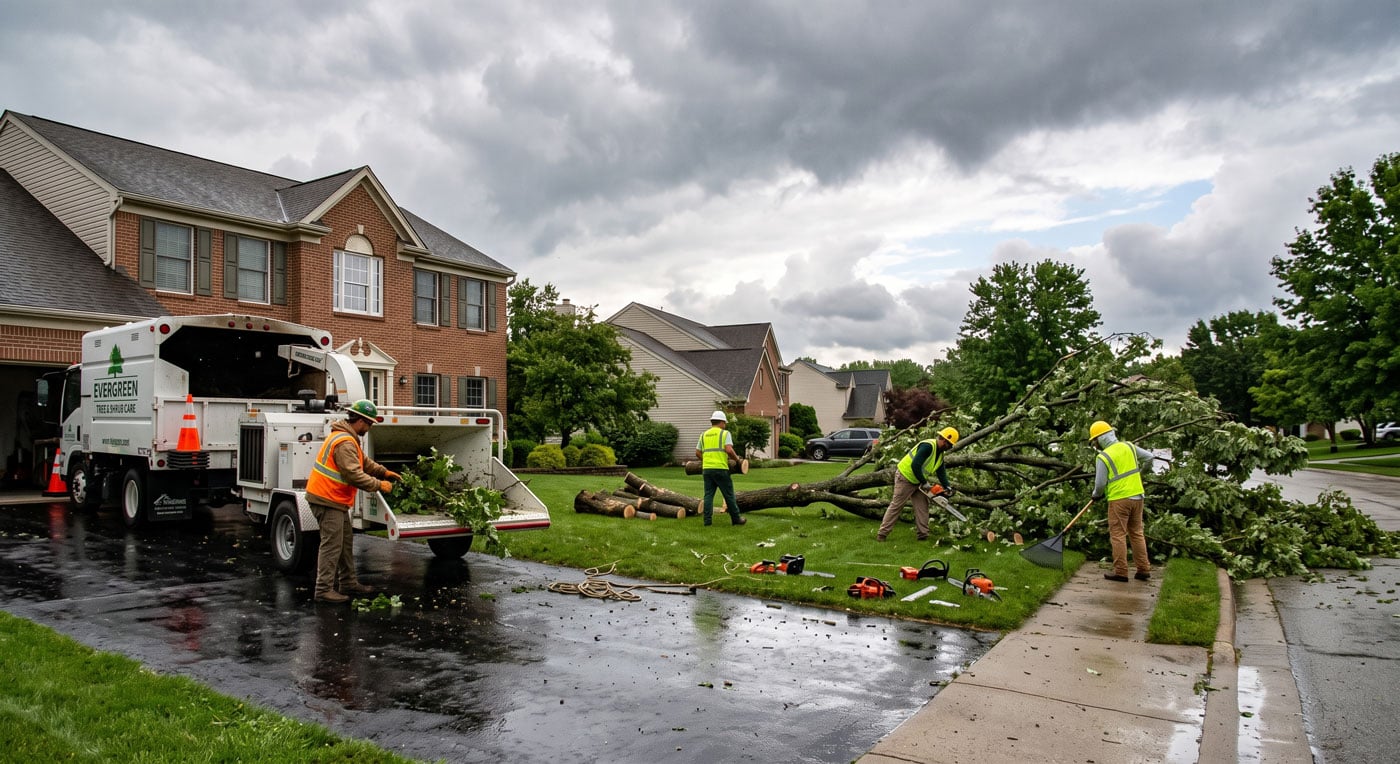
The tree service industry runs on two kinds of demand: emergency work and planned work. Emergency demand - storm damage, hazard removal, a tree that came down on a fence - is urgent, location-sensitive, and searches almost entirely on mobile within minutes of the event. Planned work - annual trimming, stump grinding, proactive removal - has a longer research cycle and a homeowner who is comparing three companies on price and reputation before calling anyone. A specialist understands that these two demand types require different channels, different messaging, and different campaign structures. A generalist treats them as the same bucket and optimizes for call volume without regard for which calls are worth taking.
Seasonality adds another layer. Tree service demand spikes after storm events and peaks in spring and fall. A specialist anticipates the storm response window, has campaigns ready to activate when a weather event hits a market, and knows how to build organic pipeline during the quieter months so the company is not entirely dependent on storm season to fill the schedule. An agency that has not worked in this trade will discover this pattern on your budget.
ISA certification and licensing requirements also vary significantly by state, which affects how Google verifies tree service companies for Google Local Services Ads. An agency that does not know the difference between a licensed arborist requirement and a general contractor license requirement will cost you time and money during the LSA verification process - one of the highest-ROI channels available to tree service companies. Google's Local Services Ads documentation makes clear that the verification process is trade-specific. Working with an agency that does not know your trade means navigating it without guidance.
What a Tree Service Marketing Specialist Understands That a Generalist Does Not
There are five areas where specialist knowledge produces measurably better outcomes for tree service companies. If an agency cannot speak specifically to each of these, they are not a specialist.
LSA Verification and Ranking for Tree Service
Google Local Services Ads put tree service companies above every organic result and every traditional paid ad, and charge per verified lead rather than per click. For most tree service companies, LSAs are the highest-ROI paid channel available. But LSA performance is driven by three factors that a generalist will not optimize correctly: review velocity, response time, and the completeness of the verification profile. A specialist knows that adding recent reviews directly improves LSA ranking - not just conversion rate - and builds a systematic review process that keeps the profile active and competitive. Our guide to Google Local Services Ads for tree service companies covers how this works in detail.
The Review System That Drives Both Rankings and Trust
Tree service is a high-trust purchase. A crew with heavy equipment is working in close proximity to the house, removing trees that could damage the property, and making judgment calls about what to take down and what to leave. Homeowners do not choose tree service companies randomly. They read reviews, compare profiles, and call the company that looks most credible. BrightLocal's Local Consumer Review Survey consistently shows that the majority of consumers read at least seven reviews before trusting a local service business. For a service as consequential as tree removal, that number is effectively every homeowner calling you.
A specialist builds a systematic review generation process tied to job completion - a text sent within 24 hours of every job with a direct link to your Google Business Profile. That system keeps your profile active, signals to Google that your business is operationally healthy, and builds the review count that determines your LSA ranking and map pack position. A generalist may mention reviews as a best practice. A specialist builds the system and tracks the results.
Storm Response Campaign Structure
When a storm moves through your market, the search behavior changes within hours. Homeowners searching "emergency tree removal" and "tree on roof repair" are not the same buyers as someone researching annual trimming. The urgency is different, the ticket value is different, and the competition for those searches is more intense than almost any other window in the year. A specialist has storm response campaigns built in advance, with pre-written ad copy, pre-approved extensions, and a launch process that can go live within the first few hours after a weather event. They monitor storm paths and market-specific weather data so they are not waiting for you to call them when demand is already spiking.
An agency without tree service experience will treat storm response like a standard campaign adjustment - increasing budget and updating headlines after the fact. That approach captures some demand. A specialist captures significantly more of it at a lower cost per lead.
The Organic Foundation That Survives Storm Season
Tree service companies that depend entirely on storm-driven leads face the same problem every spring: when the weather is quiet, the phone gets quiet. The answer is an organic foundation - service and location pages that rank for planned-work searches year-round, a Google Business Profile that stays active between storms, and content that builds visibility for searches like "tree trimming near me" and "how often should I trim my trees." That visibility does not disappear when storm season ends. It compounds.
The A+ Tree and Crane case study illustrates what this foundation produces. When The Diamond Group rebuilt their marketing system - restructuring paid channels, building a new website, and establishing a full local SEO foundation - the cost per lead dropped from $292 to $15.83. The improvement did not come from a single channel. It came from every channel pulling in the same direction. A generalist optimizes individual campaigns. A specialist builds the connected system that makes each channel reinforce the others.
Working with a specialist
You should not have to explain your trade to your marketing team
If you would rather work with a team that already understands LSAs, storm response, and the organic foundation that keeps your pipeline healthy between events, The Diamond Group builds those systems for tree service companies.
How The Diamond Group works with tree service companies →Website Conversion for Tree Service
A tree service website that does not convert is a campaign problem whether the traffic comes from organic search, LSAs, or Google Ads - because every channel you invest in eventually sends traffic to your website. The structural requirements for a converting tree service website are specific. Emergency services need to be findable in under two scrolls. The phone number needs to be click-to-call on mobile. Service-specific pages - tree removal, tree trimming, stump grinding, storm damage - each need to match the search that brought the homeowner there and make the next step obvious without requiring them to navigate. A generalist will build you a website that looks professional. A specialist builds one that is engineered to convert the specific searches a tree service homeowner uses at the specific urgency levels those searches represent.
Questions to Ask Any Agency Before You Sign
The right questions separate specialists from generalists before you write a check. An agency that struggles to answer these specifically is telling you something important.
What does your review generation process look like specifically for tree service?
The answer should describe a systematic outreach process tied to job completion, not a general recommendation to ask customers for reviews. A specialist will have a specific cadence - text within 24 hours, direct link to Google Business Profile, a simple request that does not require the customer to navigate more than one step. They should also be able to explain why review recency affects both map pack ranking and LSA ranking, not just conversion rate. If the answer is "we'll help you set up a review request template," you are talking to a generalist.
How do you structure storm response campaigns, and what does your launch process look like?
The answer should describe pre-built campaigns with specific ad copy, budget protocols, and a launch timeline measured in hours, not days. A specialist will have storm response infrastructure ready before you sign. They will be monitoring weather for your market and have a documented process for what happens when a qualifying event occurs. If the answer describes adjusting your existing campaigns after a storm, they have not thought about this problem before.
What does your Google Local Services Ads verification process look like for a tree service company?
LSA verification for tree service involves specific licensing documentation that varies by state, insurance verification with specific coverage minimums, and background check requirements for the business owner and field technicians. A specialist knows what documentation Google requires for tree service in your state, what the common sticking points are, and how to prepare for the process so it moves faster. If the answer is generic - "we'll guide you through Google's verification process" - they are discovering this information at the same time you are.
How do you measure success beyond call volume?
Gartner's research on marketing measurement consistently finds that agencies optimize for the metrics they report - and agencies that report on call volume, website traffic, and keyword rankings are not necessarily reporting on what matters to your business. The right metrics for a tree service company connect to booked jobs and average ticket value, not clicks. A specialist will ask about your average job value across service types, your target revenue per market, and how you currently track which leads turn into closed work. They will propose reporting that connects marketing spend to revenue outcome. A generalist will send you a dashboard with green arrows.
Can you show a specific tree service account and explain what you did?
This is the most important question, and the answer tells you more than any pitch deck. A specialist can walk you through a specific account - what the situation looked like before, what they built, what changed, and what the results were. They will not need to redact every detail to protect client confidentiality; they will have results they are proud of and want you to understand. The A+ Tree and Crane case study is an example of what that transparency looks like. A generalist will pivot to case studies from other trades or describe results in terms vague enough to apply to any contractor.
Red Flags That Signal a Generalist Operating Out of Their Depth
Beyond the questions above, there are signals during the sales process that tell you an agency does not understand this trade. Seeing one of these is a data point. Seeing two or more is a pattern worth taking seriously.
They lead with SEO packages and social media management before asking about your current lead sources and where the gaps are. Specialists diagnose before prescribing. They describe your customer as a homeowner with a tree problem without acknowledging that emergency work and planned work require entirely different campaigns. They cannot explain how LSA ranking is determined or what factors they would focus on to improve your position. They present a fixed monthly deliverable list - X blog posts, X social posts, X ad variations - rather than a prioritized system built around your specific growth constraint. The Content Marketing Institute's research on agency outcomes consistently finds that industry-specific agencies outperform generalists on measurable client outcomes because they bring accumulated pattern recognition that a generalist is building from scratch on every new engagement.
What the Right Agency Builds for a Tree Service Company
A specialist does not sell you a set of tactics. They build a connected system where each channel makes the others perform better. That system has a specific architecture for tree service: a Google Business Profile maintained weekly with new photos and active review management; LSAs running on top of that foundation, verified and optimized for response time and review velocity; Google Search Ads structured around planned-work searches for seasonal baseline and emergency-search campaigns ready to deploy when weather warrants; service and location pages that rank for the searches your best customers use; and a review process that runs automatically after every completed job.
When those elements are connected and maintained, the compounding effect is what produces results like the A+ Tree and Crane rebuild - where a complete system overhaul dropped cost per lead from $292 to $15.83 not because any single channel was clever, but because every channel was configured to reinforce the others. Building that system, and maintaining it as your market and your services evolve, is exactly where a specialist makes the difference.
Stop paying to learn
A generalist agency learns tree service on your budget.
The Diamond Group builds complete marketing systems for tree service companies - LSAs, Google Ads, local SEO, review generation, and storm response infrastructure - all connected and configured for how tree service leads actually work.
See how we work with tree service companiesAbout The Diamond Group
The Diamond Group is a Wilmington, NC based digital marketing and web design agency committed to helping today's small businesses grow and prosper. With a 30-year track record of success, their proprietary in-house system and concierge-level multi-disciplinary team approach to marketing guarantees double-digital growth and optimizes marketing ROI.
Related Posts
Tree Service Marketing Case Study: 1,811% More Leads